By
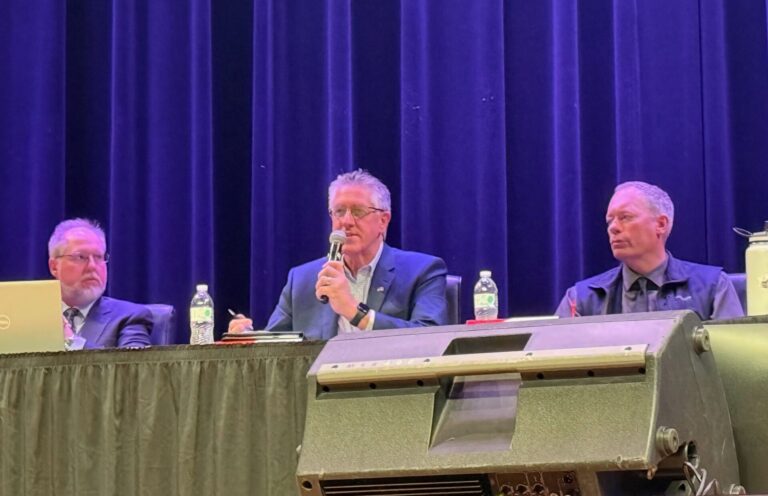
Members of the Aberdeen City Council heard 18 perspectives about data centers during a special meeting designated for community input regarding crafting an ordinance governing the operations.
Just one person spoke in favor of data centers.
The meeting was Monday, Sept. 14 at the Aberdeen Civic Theatre, a venue picked to handle a larger-than-average crowd.
No data centers have been proposed for Aberdeen, city officials have stressed. They are just seeking feedback as they develop an ordinance regulating the potential placement of data centers in the city limits.
More than one person at the Monday meeting asked council members why the issue of having data centers in town isn’t put to a public vote.
MORE: McPherson County postpones approval of Leola Data Center conditional use permit
“Why are we doing the work on an ordinance,” Liza Gingras Ronayne said. “Shouldn’t it be put to a vote of the people to see if we want a data center?”
Whatever data center ordinance the city approves could be referred to a citywide vote if enough signatures are gathered from registered voters who live in town.
Gingras Ronayne said she understands the economic benefit a data center could yield for a community, but questioned what it would be like 10 to 15 years down the road.
She noted there is already a nearby data center, though didn’t specify it.
Housing, rental markets are tight because of Ellendale workers
Applied Digital has a hyper-scale data center about 40 miles north of Aberdeen in Ellendale, N.D. That development affects Aberdeen as many temporary construction workers live in town and commute to Ellendale. One result is a tight housing and rental market.
Natalie Vernon, Clark Thares and Brodie Mueller spoke on that topic.
“I came here in the summer of 2024,” Vernon said. “I could only find two apartments to rent. Now, there are people living in hotels because there aren’t enough apartments. We can’t consider this without places for people to live.”
The city currently has a moratorium prohibiting the approval of any zoning permits related to data centers. It’s in place until Nov. 18 to give the council time to draft an ordinance with regulations.
Vernon advocated for extending the moratorium and maybe waiting a couple years to ensure sufficient housing is available.
She wasn’t the only one who advocated for a longer moratorium.
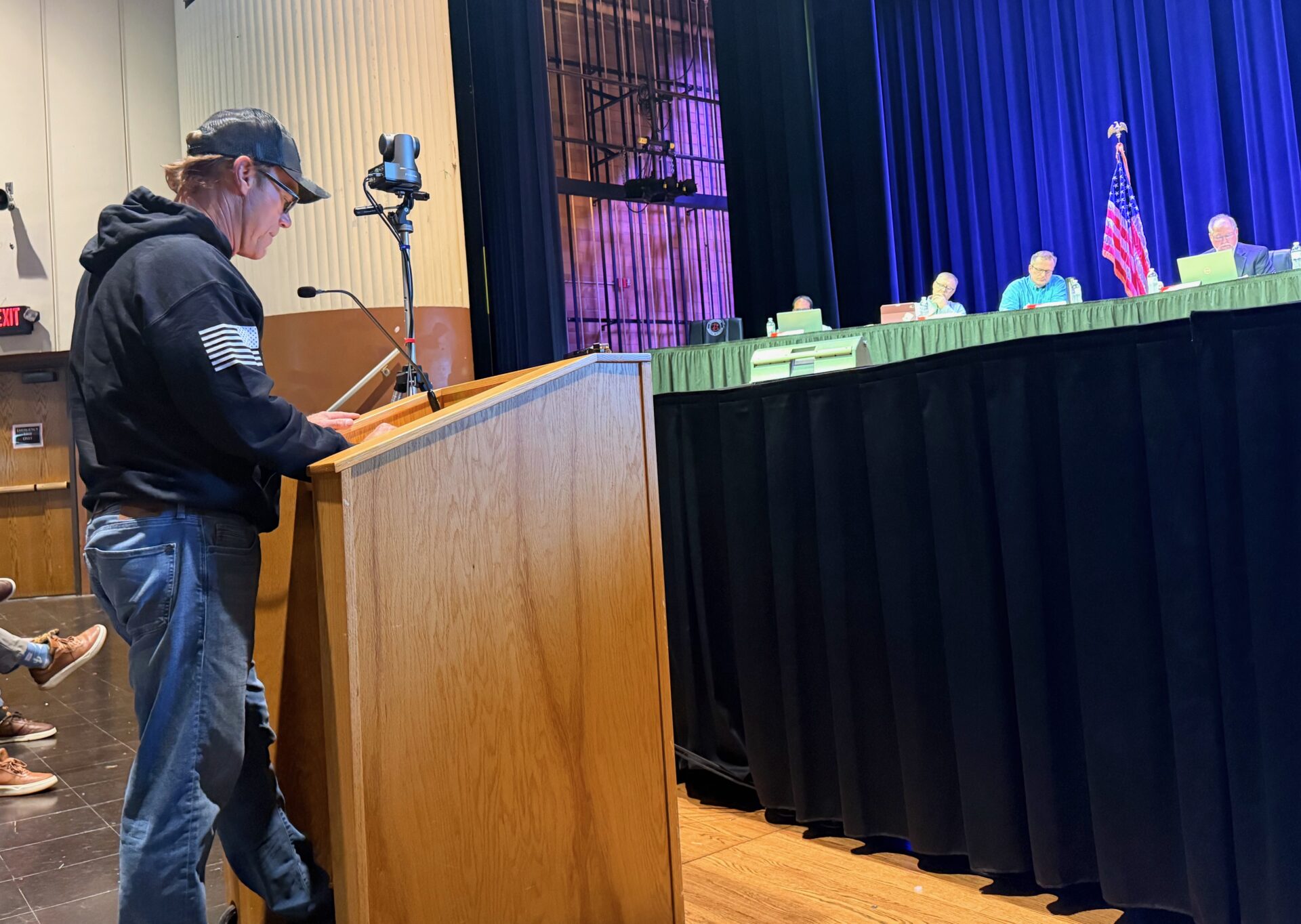
Aberdeen resident Clark Thares discusses his concerns about data centers on Monday, Sept. 14 during a special meeting of the Aberdeen City Council at the Aberdeen Civic Theatre. Aberdeen Insider photo by Elisa Sand.
Thares suggested at least a six-month moratorium extension and the appointment of a task force comprised of city officials and community members to continue studying data centers before embracing the idea.
He’s member of the Aberdeen Housing Authority Board of Directors and has previously voiced his concerns about data centers during a Brown County Commission meeting.
Mueller is the owner of The Market on the Plaza and operations director for Midwest Street Medicine, an organization that offers medical care to people who don’t have homes. He said the people Midwest Street Medicine representatives meet have income, but just can’t find affordable housing.
MORE: Aberdeen data center ordinance should outline clear expectations, ADC leader tells council
“We’ve lost half our Section 8 housing,” Mueller said.
Section 8 housing is a voucher program for low-income renters. Mueller said instead of accepting those vouchers, landlords are capitalizing on demand and increasing rent.
That means those who are looking for housing get pushed into other communities where options are also limited, he said.
“Affordable housing is an issue,” Mueller said.
Hotel rooms are also scarce, he said, which can affect the number of state tournaments that come to town.
“What happens when we lose these big things because we don’t have the room?” Mueller asked.
McPherson County officials are considering allowing a data center in the Leola area, and Mueller said that would also affect Aberdeen.
That data center would be considerably smaller than the one in Ellendale, according to the plans — 50 megawatts compared to an estimated 400 megawatts in the future for Applied Digital.
Mueller was one of at least two people who mentioned Monday news reports in which data center industry officials advocated for slowing down the pace of development.
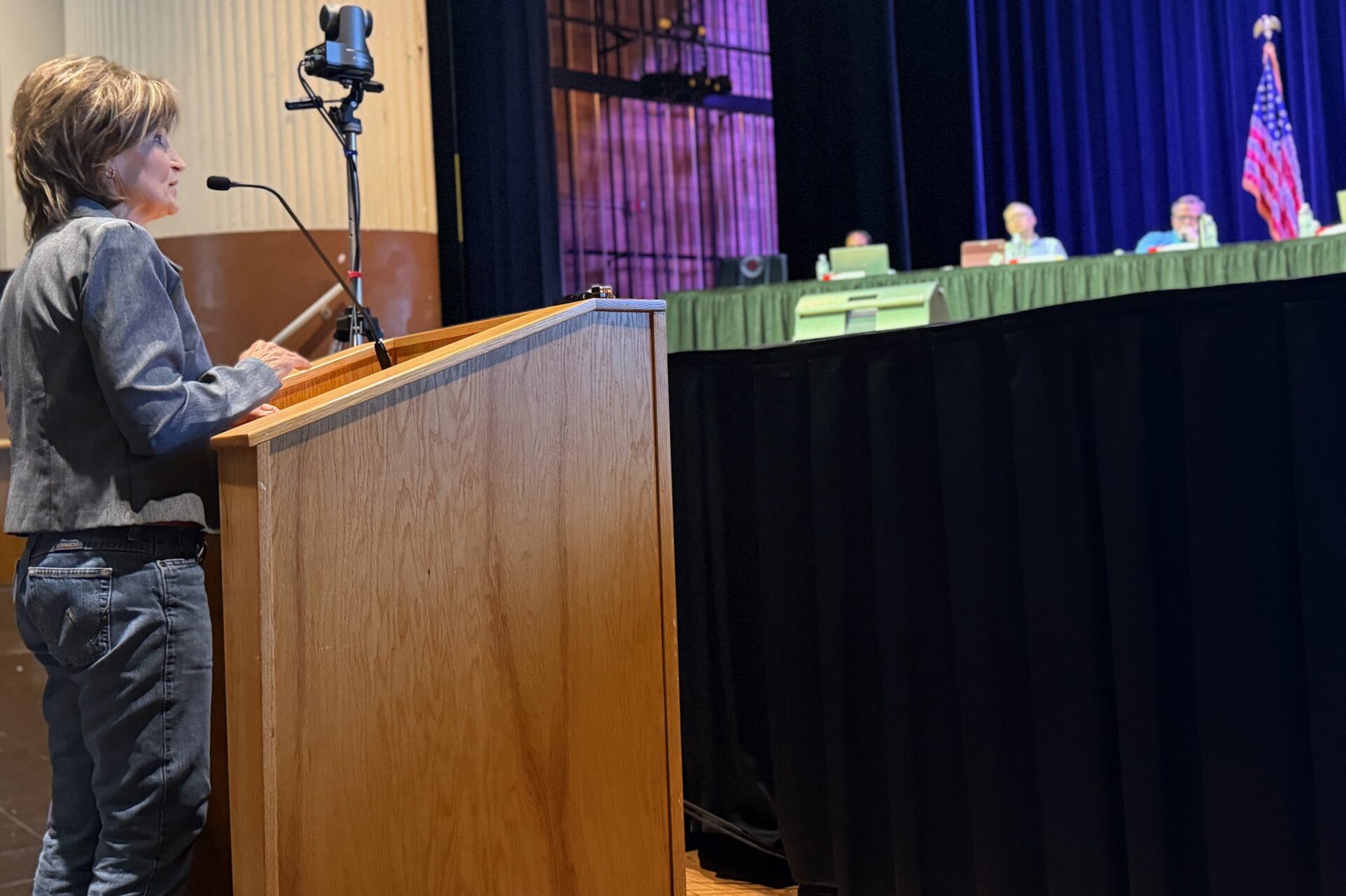
Dawn Shepard provides an overview of several concerns she has about data center noises during a special city council meeting on Monday, Sept. 14 at the Civic Theatre. Aberdeen Insider photo by Elisa Sand.
Concerns include water, electricity, health, wildlife
Many speakers voiced concerns about how much water and electricity a data center could use, the prospect of water contamination and the cost of electricity in the future.
Thares said data centers should not connect directly to the power grid or get a reduced water rate.
One-Legged Pheasant owner Ryan Clay said a hyper-scale data center could use eight times the amount of electricity it takes to power residential homes in Aberdeen. Other communities with data centers have seen considerable increases in utility rates, he said.
Clay said his utility bills have gone up recently and a further increase would be tough to manage.
Thares said the city should also limit the size of data centers and require studies on the pure tones they create.
Dawn Shepard urged the council to focus on regulating data center noise. That includes ambient noise, vibrations, infrasound and tonal noise. Of those, she said, infrasound and tonal noise are the most detrimental to a person’s health.
MORE: Data centers have moved past seeking sales tax rebates, Aberdeen council is told
Infrasound is sound that’s felt as opposed to heard, she said. Tonal noises are constant higher-frequency sounds.
“It never stops, and you never get a break from it,” she said. “If they put in the proper quality equipment, you won’t have that noise problem.”
Others, like Tasha Wells, advocated for discussion with an electrical hygienist who could study the health effects a data center could have on people. An electrical hygienist, which is also referred to as an industrial hygienist, is someone who assesses workplace and environmental hazards.
Given the small, rural nature of Aberdeen, Wells said a data center shouldn’t be allowed within city limits.
Marian Kallas also spoke on the need to consult with what she referred to as a noise hygienist. She urged caution when meeting with data center developers who dangle financial incentives in hopes of building in a community and questioned the effects data center noise could have on residents, livestock and animals native to the area like pheasants and deer.
Ann Stein noted concerns about the amount of land that would be used for a data center and how wildlife, crops and food would be affected.
Janet O’Connell voiced concerns about air pollution from companies that run data centers 24 hours a day, seven days a week. She said light pollution could disrupt wildlife patterns and a person’s circadian rhythm, or sleep-wake cycle.
Kirby Fesler, a case manager for Northeastern Mental Health Center, warned of artificial intelligence psychosis, a condition in which interaction with AI programs like chatbots can reinforce paranoia and delusions. Those cases, she said, are increasing.
Some data centers are focused on artificial intelligence.
Erin Rudner listed five items the council should consider:
- Ensuring at least 40% of the jobs created go to local residents.
- Advocating for environmental protections with annual disclosures on resources used.
- Ensuring fairness so those affected don’t face the brunt of development.
- Prohibiting nondisclosure agreements.
- Establishing a community benefit fund.
Brooke Whitney said water is something the Native American community has been concerned about for decades.
“We have been screaming for decades that water is life,” she said. “Now, we’re really getting to the point where there’s almost no return. We’re the ones who will foot the bill for water and electricity.”
Whitney also said community members have a right to know if nondisclosure agreements have been signed by anyone on the council.
“I also can’t believe this is an ordinance when we were not even given the opportunity to vote on whether we want this or not,” she said.
Broader questions posed
Peg Coutermarsh asked where council members stood on data centers in general.
“Are you a yes or a no? Are you for the future of Aberdeen or are we going to regress and do something we’re going to regret for our grandchildren for ages?” she asked.

Johnson
Because the meeting was an information-gathering session, the council did not respond to the question. Deputy Mayor Alan Johnson did, however, ask Coutermarsh what direction she considered regressive. She said she considers approving permits for a data center a bad idea when their effects aren’t yet known.
MORE: Aberdeen City Council pulls plug on license plate-reader discussion
In that vein, Lyndsey Marzenell questioned what type of information would be stored in a data center. Would a data center end up storing details collected by automatic license plate readers that community members oppose?
“Why would we want to house the box for all these cameras?” she asked.
The city council recently rejected the idea of adding cameras that read license plates.
Janell Mayer also cautioned against data center development. Yes, Aberdeen would see an influx of temporary workers, but that would come at the cost of the environment and local resources, she said.
Tony Jones questioned the value of data centers, while Rich Hilgemann spoke on the need for a transparent process and cautioned council members against accepting personal invitations to visit with representatives from data center companies outside of public meetings.
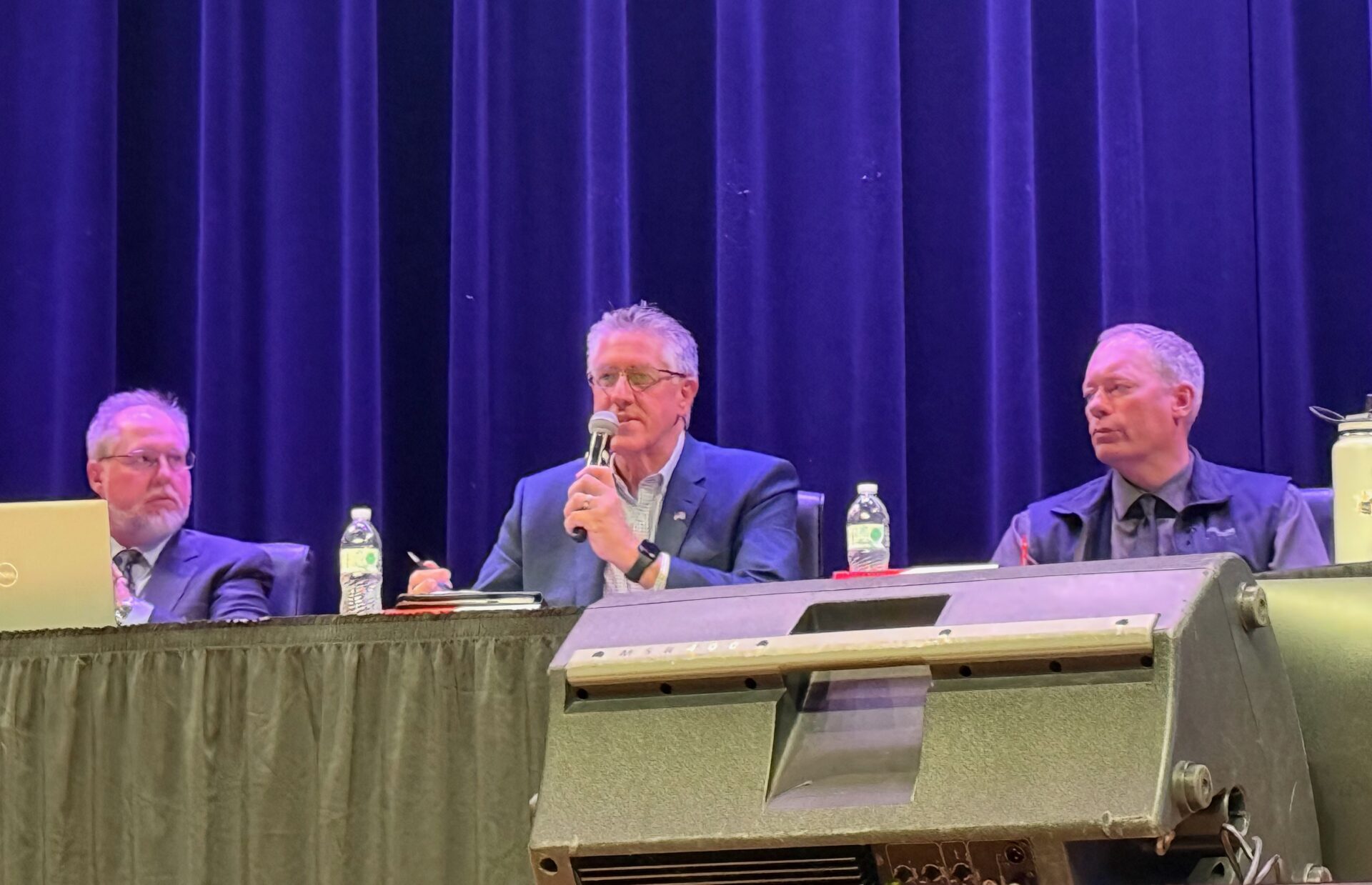
Deputy Mayor Alan Johnson called each of the 18 people who were signed up to speak at the Monday, Sept. 14 special meeting to a podium. The time was set aside to gather community input about data centers. Aberdeen Insider photo by Elisa Sand.
Not everyone was opposed
Denzel Eisenbeisz offered a different take, saying most negatives resulting from data centers could be turned into positives.
For example, any excessive heat created by a data center could be captured and used for energy, he said.
“I could go on and on,” Eisenbeisz said. “I came up with my own 45-point plan to address many issues.”
He was encouraged to submit his 45-point plan to the council.
Jobs aside, the biggest benefit data centers provide is that local government agencies collect more property taxes after they are built.
No action was taken during the meeting, and council members said very little aside from calling speakers to the podium. In the next couple of months, the council will discuss the details of a data center ordinance with plans to have it ready for consideration by the end of October. All of those meetings are open to the public and have time set aside for public comments.
MORE: Leola School awarded Farm to School grant so students can grow fruits, vegetables
The meeting was the third and final one set by the council to collect feedback. The first one was for people in the data center industry and the second was for the business community.
Each speaker Monday was limited to three minutes, though there were a few who exceeded that time by a minute or so.
A full recording of the meeting can be found on the Aberdeen City Council channel on YouTube.